


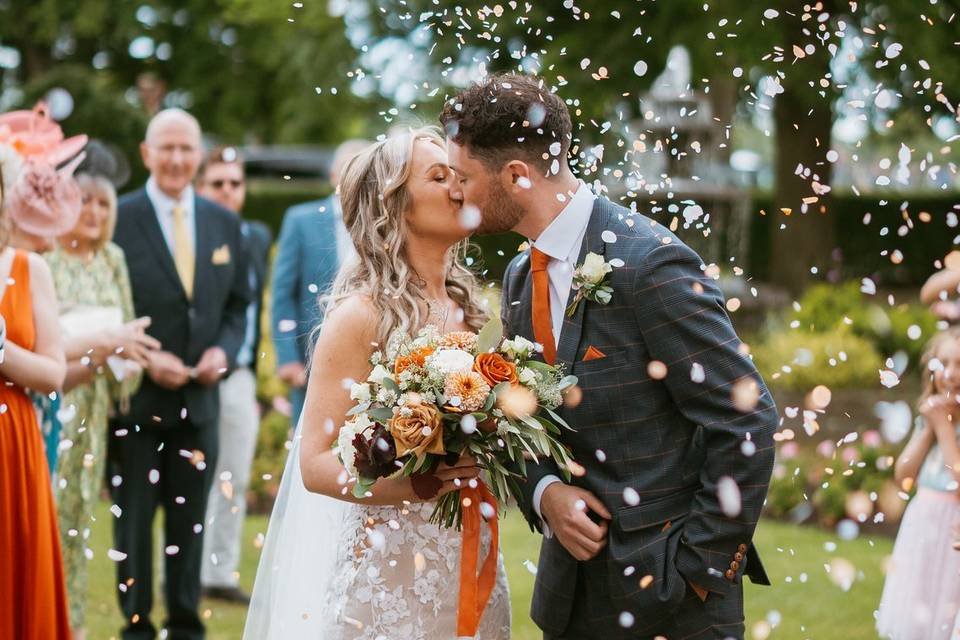
Casa Larga sits on a hill in Fairport with vineyard rows running downslope and an open sky above them. That elevation is the whole story from a camera’s point of view. It gives you clean horizons, long sightlines, and unobstructed sun from mid-morning until it drops.
It also gives you wind, no shade, and a hard deadline when the light goes.
This is a practical guide to photographing a wedding there: where the frames are, when to schedule them, what goes wrong, and how to plan around all of it.
The Vineyard Rows Are Better Than You Think, For a Narrower Window Than You Expect
Every couple who books a winery wants the vineyard photo. Two people standing between rows of vines with the lines converging behind them.
It works. The rows create natural leading lines, the height of mature vines frames people at roughly waist to chest level, and the hillside means you can shoot slightly uphill or downhill for different effects.
Here’s what nobody mentions. That image depends almost entirely on the season and the time of day.
Vine Condition by Month
| Timing | What the Vines Look Like | Photographic Result |
| April to mid May | Bare wood on wire, brown ground | Rows are structural but stark, works in black and white |
| Late May to June | New green growth, uneven fill | Rows visible, some gaps, decent |
| July to August | Full canopy, dense green, tallest | Best row definition of the year |
| September | Full canopy plus fruit, deepening color | Peak, this is the postcard month |
| October | Color turning, leaves thinning, harvest activity | Warm tones, gorgeous, but rows start opening up |
| November onward | Bare, pruned, dormant | Structural only |
If your date falls outside July through October, plan for the vineyard to be a supporting element rather than the main portrait background. That’s not a problem. It just means the photographer should be prioritizing the hillside views, the sky, and the building instead.
The Angle Nobody Uses
Most vineyard portraits are shot down the row with the couple in the middle. It’s the obvious composition and it appears in every winery gallery in the region.
The better frame is often perpendicular to the rows, from a low position, so the vines stack in horizontal bands behind the couple. It produces layers instead of a tunnel, and it works even when the canopy is thin.
Ask your photographer whether they shoot both. Variety in the vineyard set is what keeps twenty images from looking like one image.
Sun Exposure Is the Real Challenge
The hilltop position that makes the views work also means there’s almost no natural shade during portrait hours.
A June ceremony at 4:30 pm puts direct sun on faces from a high angle. Guests squint. The couple squints. Skin gets hot highlights on the forehead and nose, and white dresses blow out.
How Experienced Photographers Handle It
- Orient the ceremony so the sun is behind the couple, not behind the guests. Backlit is fixable. Front-lit squinting is not.
- Use the building’s shadow. As the sun moves west, the structure throws usable shade. A photographer who knows the property knows what time that shade reaches which side.
- Bring a scrim or a diffusion panel for portraits. Two assistants holding a large diffuser over a couple turns brutal sun into soft light. It’s not exotic equipment, and it makes an enormous difference at exposed venues.
- Shoot into the sun deliberately. Low sun through vine leaves produces flare and rim light. Done on purpose, it’s the best-looking thing at the property.
- Move the portrait block later. The single most effective fix. Every hour you push toward sunset improves the light.
Golden Hour Is Not a Bonus Here, It’s the Plan
Because the site sits high and open, the last hour before sunset is dramatically better than anything earlier. Long shadows across the hillside. Warm light on the vines. A sky that fills half the frame.
The catch is that sunset moves by nearly four and a half hours across the wedding season in the Rochester area. Late June puts it near 9 pm. Late October puts it near 6:15. Early November is closer to 5 pm.
Your entire timeline should key off that number for your specific date. Find it, work backward, and place a fifteen-minute portrait block starting about 40 minutes before.
Wind Is the Detail That Ruins Photos
High open sites are windy. This is not a small footnote.
Wind at a hilltop winery affects:
- Veils. A long veil in 15 mph wind is either a stunning image or a face-covering disaster, with no in-between. Have someone assigned to manage it.
- Hair. Especially loose styles. Bring pins and a small brush to portraits.
- Ceremony audio. Not a photography issue directly, but it affects video and it affects whether the officiant moves the setup.
- Aisle decor and florals. Tall arrangements go over. Photographers end up shooting around a fallen centerpiece.
- Drone flight. Hilltop wind frequently exceeds safe operating limits even when it feels mild at the parking lot.
None of this is a reason to avoid the venue. It’s a reason to have a plan and a small kit: bobby pins, hairspray, a comb, and a designated person whose job during portraits is fixing what the wind moves.
A Full-Day Timeline Built for This Property
Here’s a working example for a September wedding with sunset around 7:20 pm.
| Time | Activity | Photography Note |
| 12:30 pm | Photographer arrives, getting ready | Interior spaces, window light, details |
| 2:00 pm | Dress and final prep | Best emotional window of the day |
| 2:45 pm | First look on the property | Choose a shaded or building-adjacent spot, sun is still high |
| 3:00 pm | Couple portraits, round one | Shorter set, keep energy up |
| 3:30 pm | Bridal party | Building shade side, avoid open sun |
| 4:15 pm | Guests arrive, couple hidden | Second shooter covers arrivals and details |
| 4:30 pm | Ceremony | Sun behind the couple, guests not squinting |
| 5:10 pm | Family photos | 15 minutes, named list, shaded backdrop |
| 5:30 pm | Cocktail hour | Candids, venue wides, guest coverage |
| 6:30 pm | Dinner and toasts | Reaction coverage |
| 6:40 pm | Golden hour portraits, round two | The images you’ll print, 15 minutes, vineyard rows |
| 8:00 pm | First dance and open floor | Flash work begins |
| 9:30 pm | Night portraits with vines | Optional, off-camera flash, five minutes |
| 10:30 pm | Coverage ends |
Notice that portraits happen twice. Splitting them is the single best structural decision for an outdoor venue, because it lets you capture usable images early and exceptional ones late, without asking anyone to stand in a field for ninety consecutive minutes. Any experienced Wedding Photographer Rochester couples hire for a hilltop property will suggest this split before you ask for it.
The Rain Plan Deserves a Real Conversation
Fairport gets rain, and a hilltop offers nowhere to hide.
Confirm with the venue exactly what the indoor ceremony configuration looks like, then send that information to your photographer. Indoor backup spaces at wineries tend to be lower-ceilinged and warmer-toned than the main outdoor site, which changes lighting entirely.
Also confirm the cutoff time for the decision. Most venues need a call several hours ahead. That’s frustrating when the radar looks split, and it’s why your photographer should be in the group text: they can tell you whether a 40-minute gap in the rain is enough to get outside for portraits.
Umbrellas matter more than people expect. Clear umbrellas photograph well because faces stay visible. Solid dark ones put everyone in shadow. Buy six clear ones and keep them in a car. They cost almost nothing and they save the portrait set.
One Sentence About Guest Footwear
Tell your guests it’s a grass and gravel property, because heels sinking into a vineyard row is a problem everyone discovers at the same time.
The Ceremony Orientation Decision
This gets made by a planner or a coordinator, usually without consulting the photographer, and it determines the quality of every ceremony image you receive.
Three orientations are possible on an open hilltop site, and they produce very different results.
| Orientation | Couple’s Light | Guests’ Comfort | Photographic Result |
| Sun behind the couple | Backlit, rim-lit hair, faces in open shade | Guests face the sun, some squinting | Best images by a wide margin, needs fill or reflector |
| Sun behind the guests | Faces in full direct sun | Guests comfortable | Squinting couple, hard shadows, blown highlights on the dress |
| Sun to one side | Split light across faces | Mixed | Workable, uneven, harsh nose shadows at high sun |
The first option wins for photographs and costs guests a bit of comfort. The second wins for guests and costs you the ceremony gallery.
Most couples pick option two by accident because it’s the orientation that puts the best view behind the couple. There’s usually a way to get both if someone rotates the setup twenty degrees, and that conversation needs to happen weeks ahead with the venue, the planner, and the photographer in the same email thread.
Ask One Question at the Walkthrough
“At my ceremony start time, where will the sun be relative to the aisle?”
A venue coordinator who has run a hundred weddings on that lawn will answer immediately. If nobody knows, your photographer can work it out from the date and the site orientation in about two minutes.
Details and Interiors Worth Shooting
The property isn’t only outdoor frames. A strong gallery includes:
- Barrel and tank areas, which give dark, textured backgrounds with a strong sense of place
- Tasting room interiors with warm wood and controlled light
- The approach and entry, useful as an establishing frame
- Glassware and place settings, which tie the wine theme into detail images without being heavy-handed
- Windows overlooking the hillside, which let you shoot a portrait indoors with the vineyard visible behind
Ask your photographer to build in ten minutes for interior work. It gives the gallery contrast against a set that would otherwise be entirely bright and outdoor.
What to Ask the Venue Before Your Photographer Arrives
Get written answers to these and forward them along.
| Question | Why It Matters to Photos |
| Are we allowed into the vineyard rows, and which ones? | Access varies, especially near harvest |
| What time does the building shade reach the ceremony lawn? | Determines squint risk |
| Is drone flight permitted on the property? | Separate from FAA rules, venue policy applies |
| What is the rain call deadline? | Determines how late a decision can be made |
| Can we return outside after dinner for portraits? | Some venues restrict movement once the reception starts |
| Are there restrictions on lighting equipment or stands? | Affects night portraits and reception flash |
| Which indoor spaces are available for getting ready? | Window quality determines the morning gallery |
That third row catches people out. Venue permission and FAA airspace approval are two different things, and you need both.
Conclusion
Casa Larga photographs well because of elevation, open sky, and vineyard rows that give a portrait real structure. It photographs badly when the sun is high, the wind is up, and the timeline was built without checking sunset.
Do four things and the day works. Find your exact sunset time and place a fifteen-minute portrait block about forty minutes before it. Split portraits into two rounds instead of one long session. Assign someone to manage veil and hair in wind. And get the venue’s answers on vineyard access, shade timing, and the rain deadline in writing before your photographer builds the schedule.
The property gives you a strong set of images with very little effort during the right hours. The whole job is making sure you’re outside during those hours.
